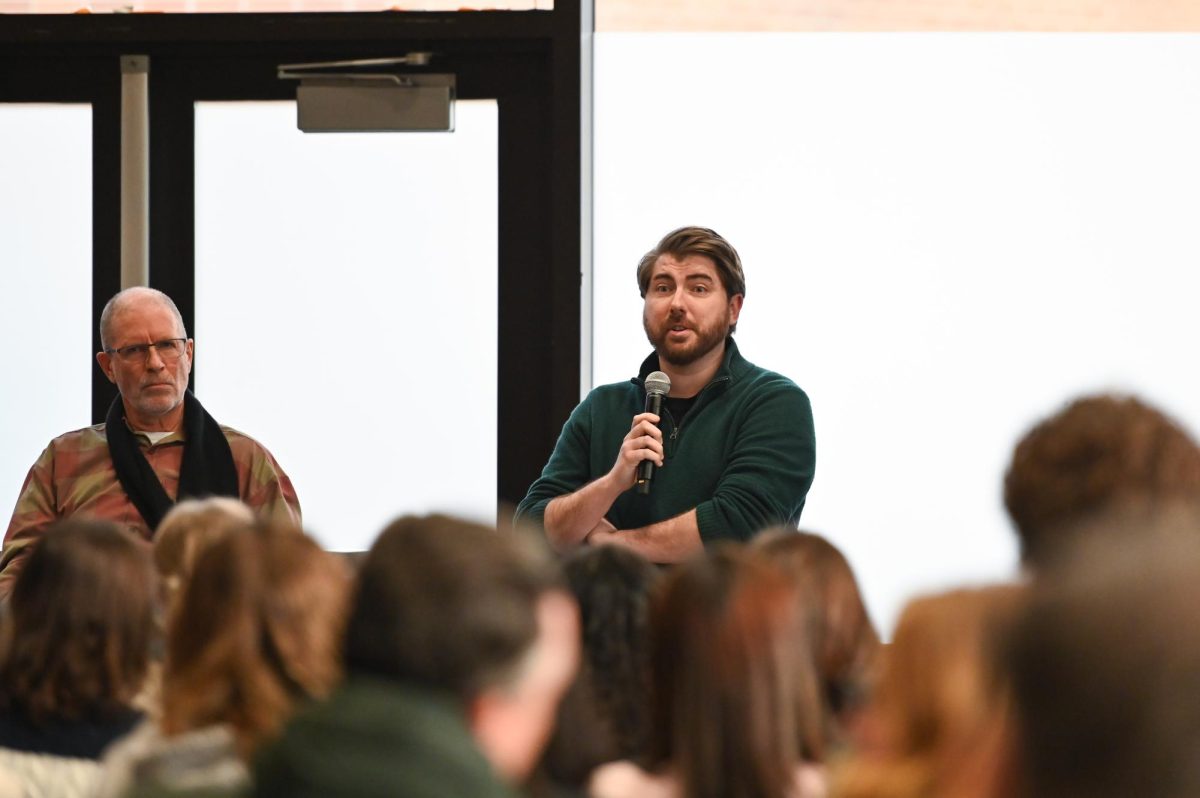
On Sept. 17, a Constitution Day Lecture was held in the Robinson Teaching Theatre (RTT) to discuss how ‘Free Speech Isn’t Meant to be Easy’ with attorney Lindsie Rank.
Lindsie Rank is a First Amendment attorney who began working at the Foundation for Individual Rights and Expression (FIRE) as an intern in 2015 and is now the director of campus rights advocacy for the organization. Erica Salkin, the dean of Whitworth’s College of Arts, Sciences and Education, introduced Rank as one of her past students who went on to pursue a career in legally defending free speech.
When Rank took the stage, she began by giving context for the specific topic of free speech. Rank discussed the recent assassination of right-wing political podcaster Charlie Kirk, saying, “When we talk about free speech, we cannot only mean the free speech that we like.”
She used the aftermath of his killing, including people being fired for their support or lack thereof for Kirk, as proof of how free speech is worth protecting. Rank claimed that the censorship of one, Kirk, can lead to censorship for the masses. She described what protected free speech in America looks like, including protests, drag shows, prayer vigils and hate speech. She also made it clear that free speech isn’t harassment that threatens individual rights or safety.
Rank emphasized how she believes that, despite the difficulty of disagreeing with people and the discomfort of it all, censorship won’t be helpful to our society in terms of moving forward.
An audience member questioned racial bias in the legal protection of free speech, using the example of the Ku Klux Klan continuing to be active while the Black Panther Party was dismantled in 1982. Rank responded to this, clarifying, “I’m not saying the First Amendment is perfect,” and went on to explain that it’s better than the alternative of censorship.
When asked how we as a society can balance having dialogue without facilitating violent rhetoric or speech that encourages violent behavior, Rank said, “I don’t necessarily believe that speech is violence.” She ended with an emphasis on personal responsibility for violent responses to free speech, telling the audience, “You never know when that [uncomfortable] speech is going to blossom into a movement.”