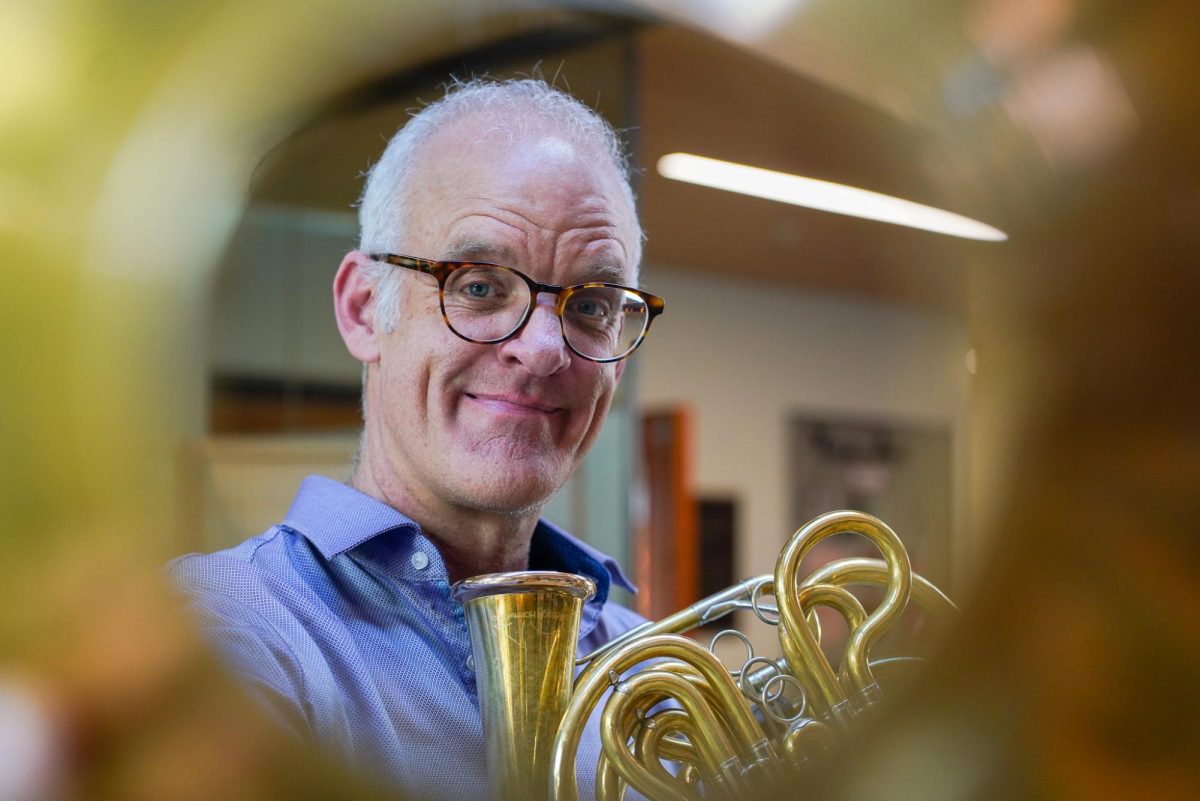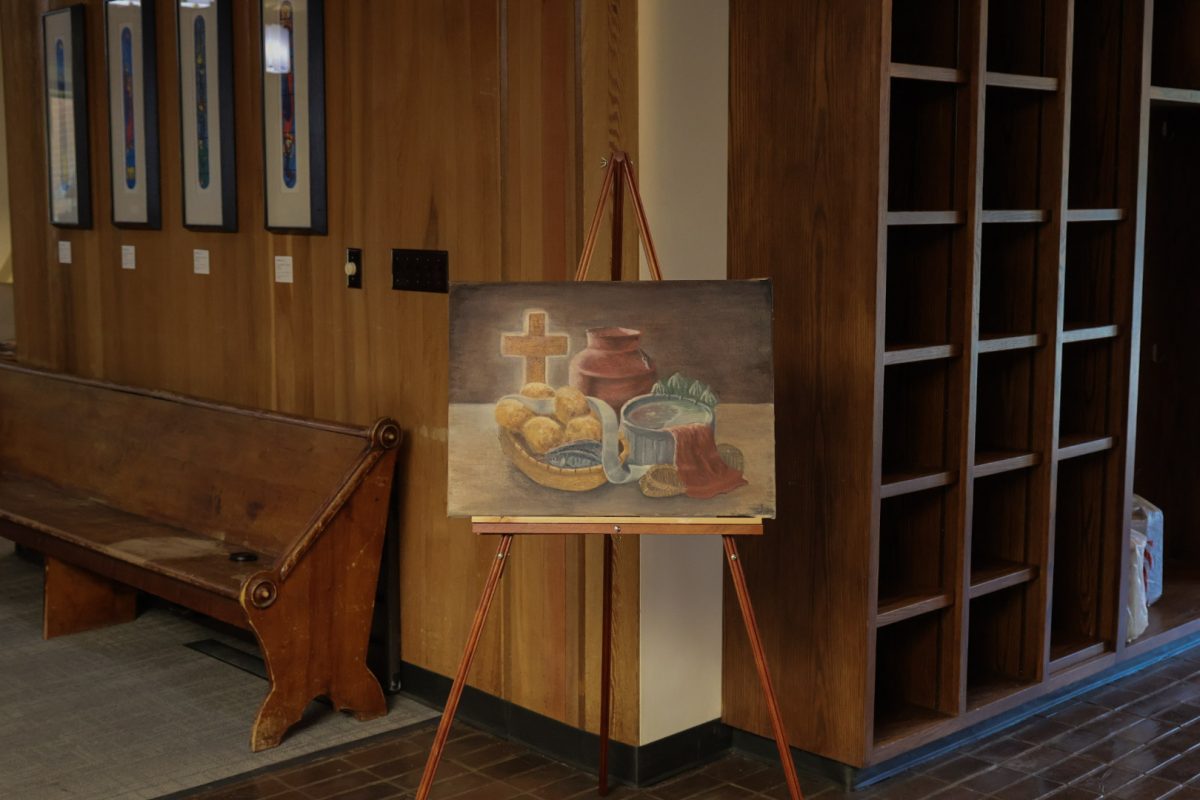
What do a flowerpot and a chair have in common? For chapel artist Byeongchan Jeong, they share evidence of the faith of God. Through two seemingly random objects, Chan was able to illustrate a powerful description of the redemptive love of God for his series in collaboration with the Whitworth Chapel.
The reason for choosing each individual artist changes from year to year. For Benjamin Brody, professor of church music and a member of the committee responsible for choosing Chan, there were a few different key features of Chan that factored into their decision. For Brody and the group of campus worship leaders involved in this choice, it went beyond simply Chan’s artistic ability.
Reflecting on why he chose Chan, Brody said the following: “We were impressed with Chan’s skill as an artist and the care and thought he gives to deep theological reflection, which then influences his art for worship.”
Chan was chosen for this introspective nature, but also due to his familiarity with the chapel. Brody said that Chan is also an excellent pianist who plays for one of the Whitworth worship teams.
“In our weekly discussions with our campus worship team leaders, he brings a unique perspective that helps all of us to consider the role of the arts in worship beyond just music,” said Brody.
This desire to be involved in campus ministry for Chan came from his childhood in India with his missionary parents. Originally living in South Korea, he spent long portions of his life traveling to other countries to spread the gospel. For Chan, his faith is a simple matter.
“I think, like, I’m a Christian because my parents are Christians too, but I didn’t really think too much about what God is like, because he was kind of always there for me,” Chan said.
Art became a source of inspiration and a way to process his faith when he moved away from his parents. For Chan, it always went beyond simply reading the bible and attending church, though those things were deeply important for him. His faith was illustrated and understood through his art.
“I was trying to question God more and more, and art really helped me a lot to know who God is,” said Chan. “Because just reading the bible is good, awesome, but sometimes boring. And also, it’s really hard to understand sometimes.”
Art was a tool through which to comprehend the Bible and to contextualize his faith.
“Just knowing how to make art helped me to understand the Bible, all scriptures, like visualizations,” said Chan.
The images flowed naturally from his reading of the Bible.
“I didn’t really study art in high school, and I don’t know any techniques, like, even now … but when it comes to me going for God, like reading the Bible, I just have the pictures in my head, and I just put it right into my art,” he said.
This affinity for and enjoyment of art caught the eye of Benny Fountain, a professor of art here at Whitworth, who had him in a painting class and noticed the joy he took.

“I never planned it before,” said Chan. “It just like came in the middle of nowhere. Like, oh, I should enjoy this.”
This self-reflection and earnest faith played into every step of Chan’s selection as chapel artist. After having Chan in some of his classes, Fountain recommended him for the chapel artist.
For Fountain, it was Chan’s faith that inclined him to be a chapel artist.
“I knew that he was a person clearly engaged with his faith,” said Fountain, “And that his faith was a centerpiece of what he wanted to explore as an artist.”
But not only his faith intrigued Fountain.
“I also knew Chan to be a reflective person,” said Fountain, “Chan can think deeply and slowly, and he can focus. And those are key qualities that are necessary for making art of any kind.”
This self-reflective nature developed into the two pieces Chan has created for the chapel series so far. With “The Chair” and “Flowerpot,” Chan demonstrated two of the three key talking points of the chapel. His three key points were God’s calling, God’s plan and God’s judgment.
To illustrate God’s judgment in a painting was no small task. But Chan broke it down into a simple, digestible illustration as he is prone to do. For him, God’s judgment is represented by a painting of a chair.
“I use the chair as the subject matter of judgment,” said Chan, “It’s like how parents put their children to sit in the chair and try and think what they did wrong. And I kind of feel like how God’s judgment is like the same.”
For Chan, this judgment is a method to remind us that we are sinners, not just to punish us, and that the only way to get out of that is by believing in God.
“So I didn’t want judgment to be like cruel things or brutal things,” said Chan, “I want it to be something like they can just sit and reflect on themselves, to know who they are.”
The chair sits on a blue background, positioned in the left corner of a room. The second painting in the series sits on a separate canvas but is set in the same blue room in the right corner.
This painting depicts God’s calling. He references the story of Samuel and the story of Eli. How both had their own calling from God.
“I think of an object that really helped to understand God’s calling,” said Chan, “It’s like a pot. People can have nutrition from the soil so that they can grow plants. The main focus is the pot not the flower.”